Arize Phoenix vs Opik
In short
Arize Phoenix vs Opik: both are coding tools on Scriptiii AI Tools. Arize Phoenix pricing: Free. Free to use. (reported by the maker) Opik pricing: Free. Free to use. (reported by the maker) Both have 0 upvotes.
- Arize Phoenix
- Free. Free to use. (reported by the maker)
- Opik
- Free. Free to use. (reported by the maker)
- Upvotes
- 0 vs 0
| Field | Arize Phoenix | Opik |
|---|---|---|
| Page | Arize Phoenix | Opik |
| Pricing (maker-reported) | Free. Free to use. | Free. Free to use. |
| Upvotes | 0 | 0 |
| Best for | ai-agents, tool, observability-evals | ai-agents, tool, observability-evals |
| Tagline | AI observability and evaluation tool for tracing and evaluating LLM applications. | Comet open-source platform for tracing, evaluating and monitoring LLM apps and agents. |
| Website | Visit Arize Phoenix | Visit Opik |
Pricing and pricing details come from the maker's submission. They are not independently verified.
Arize Phoenix
๐บ๐ธ English โข ๐จ๐ณ ไธญๆ โข ๐น๐ผ ็น้ซไธญๆ โข ๐ฏ๐ต ๆฅๆฌ่ช โข ๐ต๐น Portuguรชs โข ๐ง๐ท Portuguรชs โข ๐ฐ๐ท ํ๊ตญ์ด โข ๐ช๐ธ Espaรฑol โข ๐ฉ๐ช Deutsch โข ๐ซ๐ท Franรงais โข ๐ฎ๐ฑ ืขืืจืืช โข ๐ธ๐ฆ ุงูุนุฑุจูุฉ โข ๐ท๐บ ะ ัััะบะธะน โข ๐ต๐ฑ Polski โข ๐จ๐ฟ ฤeลกtina โข ๐ณ๐ฑ Nederlands โข ๐น๐ท Tรผrkรงe โข ๐บ๐ฆ ะฃะบัะฐัะฝััะบะฐ โข ๐ป๐ณ Tiแบฟng Viแปt โข ๐ต๐ญ Tagalog โข ๐ฎ๐ฉ Indonesia โข ๐น๐ญ เนเธเธข โข ๐ฎ๐ณ เคนเคฟเคจเฅเคฆเฅ โข ๐ง๐ฉ เฆฌเฆพเฆเฆฒเฆพ โข ๐ต๐ฐ ุงุฑุฏู โข ๐ท๐ด Romรขnฤ โข ๐ธ๐ช Svenska โข ๐ฎ๐น Italiano โข ๐ฌ๐ท ฮฮปฮปฮทฮฝฮนฮบฮฌ โข ๐ญ๐บ Magyar โข ๐ซ๐ฎ Suomi โข ๐ฉ๐ฐ Dansk โข ๐ณ๐ด Norsk
Arize Phoenix is Arize's open-source AI observability platform designed for experimentation, evaluation, and troubleshooting. For managed production workflows, Arize also offers Arize AX. Phoenix provides:
- Tracing - Trace your LLM application's runtime using OpenTelemetry-based instrumentation.
- Evaluation - Leverage LLMs to benchmark your application's performance using response and retrieval evals.
- Datasets - Create versioned datasets of examples for experimentation, evaluation, and fine-tuning.
- Experiments - Track and evaluate changes to prompts, LLMs, and retrieval.
- Playground- Optimize prompts, compare models, adjust parameters, and replay traced LLM calls.
- Prompt Management- Manage and test prompt changes systematically using version control, tagging, and experimentation.
- PXI (Phoenix Intelligence) - An AI engineering agent built into Phoenix for debugging traces, iterating on prompts, and navigating the product.
- Remote MCP Server - Connect Claude Code, Cursor, and other MCP clients directly to your Phoenix instance's
/mcpendpoint to query traces, datasets, experiments, and more.
Phoenix is vendor and language agnostic with out-of-the-box support for popular frameworks (OpenAI Agents SDK, Claude Agent SDK, LangGraph, Vercel AI SDK, Mastra, CrewAI, LlamaIndex, DSPy) and LLM providers (OpenAI, Anthropic, Google GenAI, Google ADK, AWS Bedrock, OpenRouter, LiteLLM, and more). For details on auto-instrumentation, check out the OpenInference project.
Phoenix runs practically anywhere, including your local machine, a containerized deployment, or in the cloud. See Self-Hosting for a walkthrough of each option, or jump straight into the Tracing Quickstart.
[!NOTE]
Phoenix is open-source and self-hosted. For a managed platform, Arize offers Arize AX โ the same OpenTelemetry/OpenInference instrumentation works with both. See the full comparison.
Table of Contents
- Run Locally
- Trace Your Application
- Deploy
- Packages
- Tracing Integrations
- Sandboxes
- For Humans and Coding Agents
- Security & Privacy
- Community
Run Locally
Install Phoenix via pip or conda and have a fully functional Phoenix. For all installation and hosting options, see the install guide.
pip install arize-phoenix
phoenix serve
Or run it with no install using uvx:
uvx arize-phoenix serve
Trace Your Application
The fastest way to send traces is to let your coding agent (Claude Code, Codex, Cursor, and others) instrument your app. From your project directory, run:
npx @arizeai/phoenix-cli setup
## or, with Phoenix installed: px setup
Setup detects your framework and LLM provider, installs the right OpenInference instrumentation, and wires up trace export. Prefer to wire it up in code? See the tracing documentation.
Deploy
Phoenix container images are available via Docker Hub and can be deployed using Docker or Kubernetes via the Helm chart.
For Docker Compose, Kubernetes/Helm, and other deployment options, see the self-hosting documentation.
[!NOTE]
The Google Cloud button builds Phoenix from source in Cloud Shell rather than deploying the prebuilt Docker Hub image. The Azure template serves plain HTTP (Azure Container Instances does not terminate TLS) โ front it with a TLS proxy such as an Application Gateway before production use.
Packages
The arize-phoenix package includes the entire Phoenix platform. However, if you have deployed the Phoenix platform, there are lightweight Python sub-packages and TypeScript packages that can be used in conjunction with the platform.
Python Subpackages
| Package | Version & Docs | Description |
|---|---|---|
| arize-phoenix-otel | Provides a lightweight wrapper around OpenTelemetry primitives with Phoenix-aware defaults | |
| arize-phoenix-client | Lightweight client for interacting with the Phoenix server via its OpenAPI REST interface | |
| arize-phoenix-evals | Tooling to evaluate LLM applications including RAG relevance, answer relevance, and more |
TypeScript Subpackages
| Package | Version & Docs | Description |
|---|---|---|
| @arizeai/phoenix-otel | Provides a lightweight wrapper around OpenTelemetry primitives with Phoenix-aware defaults | |
| @arizeai/phoenix-client | Client for the Arize Phoenix API | |
| @arizeai/phoenix-evals | TypeScript evaluation library for LLM applications (alpha release) | |
| @arizeai/phoenix-cli | CLI for fetching traces, datasets, and experiments for use with Claude Code, Cursor, and other coding agents |
Tracing Integrations
Phoenix is built on top of OpenTelemetry and is vendor, language, and framework agnostic. For details about tracing integrations and example applications, see the OpenInference project and the integrations documentation.
Python Integrations
| Integration | Package | Version | |
|---|---|---|---|
| OpenAI | openinference-instrumentation-openai | ||
| OpenAI Agents | openinference-instrumentation-openai-agents | ||
| LlamaIndex | openinference-instrumentation-llama-index | ||
| DSPy | openinference-instrumentation-dspy | ||
| AWS Bedrock | openinference-instrumentation-bedrock | ||
| LangChain | openinference-instrumentation-langchain | ||
| LangGraph | openinference-instrumentation-langchain | ||
| MistralAI | openinference-instrumentation-mistralai | ||
| Cohere | openinference-instrumentation-cohere | ||
| Together AI | openinference-instrumentation-together | ||
| Ollama | openinference-instrumentation-ollama | ||
| Google GenAI | openinference-instrumentation-google-genai | ||
| Google ADK | openinference-instrumentation-google-adk | ||
| Guardrails | openinference-instrumentation-guardrails | ||
| VertexAI | openinference-instrumentation-vertexai | ||
| CrewAI | openinference-instrumentation-crewai | ||
| Haystack | openinference-instrumentation-haystack | ||
| LiteLLM | openinference-instrumentation-litellm | ||
| OpenRouter | openinference-instrumentation-openai | ||
| OrcaRouter | openinference-instrumentation-openai | ||
| Groq | openinference-instrumentation-groq | ||
| Instructor | openinference-instrumentation-instructor | ||
| Anthropic | openinference-instrumentation-anthropic | ||
| Smolagents | openinference-instrumentation-smolagents | ||
| Agno | openinference-instrumentation-agno | ||
| BeeAI | openinference-instrumentation-beeai | ||
| Strands Agents | openinference-instrumentation-strands-agents | ||
| Restate | openinference-instrumentation-openai-agents | ||
| MCP | openinference-instrumentation-mcp | ||
| Microsoft Agent Framework | openinference-instrumentation-agent-framework | ||
| Pydantic AI | openinference-instrumentation-pydantic-ai | ||
| Pipecat | openinference-instrumentation-pipecat | ||
| AG2 | openinference-instrumentation-ag2 | ||
| Autogen AgentChat | openinference-instrumentation-autogen-agentchat | ||
| Portkey | openinference-instrumentation-portkey | ||
| Agent Spec | openinference-instrumentation-agentspec | ||
| Claude Agent SDK | openinference-instrumentation-claude-agent-sdk | ||
| TypeSafe AI | openinference-instrumentation-typesafe | ||
| Atomic Agents | atomic-agents[observability] |
Span Processors
Normalize and convert data across other instrumentation libraries by adding span processors that unify data.
| Package | Description | Version |
|---|---|---|
openinference-instrumentation-openlit | OpenInference Span Processor for OpenLIT traces. | |
openinference-instrumentation-openllmetry | OpenInference Span Processor for OpenLLMetry (Traceloop) traces. |
JavaScript Integrations
| Integration | Package | Version | |
|---|---|---|---|
| OpenAI | @arizeai/openinference-instrumentation-openai | ||
| OpenAI Agents | @arizeai/openinference-instrumentation-openai-agents | ||
| LangChain.js | @arizeai/openinference-instrumentation-langchain | ||
| TanStack AI | @arizeai/openinference-tanstack-ai | ||
| Vercel AI SDK | @arizeai/openinference-vercel | ||
| BeeAI | @arizeai/openinference-instrumentation-beeai | ||
| Claude Agent SDK | @arizeai/openinference-instrumentation-claude-agent-sdk | ||
| Mastra | @mastra/arize | ||
| MCP | @arizeai/openinference-instrumentation-mcp | ||
| TypeSafe AI | @arizeai/openinference-instrumentation-typesafe |
Java Integrations
| Integration | Package | Version | |
|---|---|---|---|
| LangChain4j | openinference-instrumentation-langchain4j | ||
| SpringAI | openinference-instrumentation-springAI | ||
| Arconia for Spring AI | io.arconia:arconia-openinference-semantic-conventions | ||
| Google ADK | openinference-instrumentation-adk-java |
Go Integrations
| Integration | Package | Version | |
|---|---|---|---|
| OpenAI | github.com/Arize-ai/openinference/go/openinference-instrumentation-openai-go | ||
| Anthropic | github.com/Arize-ai/openinference/go/openinference-instrumentation-anthropic-sdk-go |
Platforms
| Platform | Description | Docs | |
|---|---|---|---|
| BeeAI | AI agent framework with built-in observability | Integration Guide | |
| Dify | Open-source LLM app development platform | Integration Guide | |
| Envoy AI Gateway | AI Gateway built on Envoy Proxy for AI workloads | Integration Guide | |
| LangFlow | Visual framework for building multi-agent and RAG applications | Integration Guide | |
| LiteLLM Proxy | Proxy server for LLMs | Integration Guide | |
| Flowise | Visual framework for building LLM applications | Integration Guide | |
| Prompt Flow | Microsoft's prompt flow orchestration tool | Integration Guide | |
| NVIDIA NeMo | NVIDIA NeMo Agent Toolkit for enterprise agents | Integration Guide | |
| Graphite | Multi-agent LLM workflow framework with visual builder | Integration Guide |
Vector Databases
| Integration | Description | Docs |
|---|---|---|
| Qdrant | Staged hybrid search tracing with dense, sparse, RRF | Integration Guide |
Sandboxes
Run Phoenix code evaluators in hosted sandbox providers for kernel-level isolation and runtime dependency installation.
| Integration | Description | Docs |
|---|---|---|
| E2B | Hosted micro-VM sandboxes for AI-generated code | Integration Guide |
| Daytona | Managed development sandboxes with snapshot startup | Integration Guide |
| Vercel Sandbox | Ephemeral compute on Vercel's infrastructure | Integration Guide |
| Modal | Serverless, Python-first container platform | Integration Guide |
| Docker Sandboxes | Cloud sandboxes hosted by Docker | Integration Guide |
For Humans and Coding Agents
People and coding agents such as Claude Code, Codex, and Cursor can both work with Phoenix. To give an agent access to your traces, datasets, and experiments, connect it in one of these ways:
- Claude Code or Codex. Install the Arize Phoenix plugin. It registers the Phoenix MCP server and installs the Phoenix skills.
- Any other agent. Add the Remote MCP Server at your instance's
/mcpendpoint. It serves your Phoenix data and the Phoenix skills, which match your server version. - Optional CLI. The Phoenix CLI,
npx @arizeai/phoenix-cli, runs Phoenix commands in a terminal, andpx setupinstruments your app through your coding agent.
See Connect Your Coding Agent for setup steps.
The skills live in skills/ and teach agents how to trace, evaluate, and debug with Phoenix:
| Skill | Description |
|---|---|
| phoenix-cli | Debug LLM applications with the Phoenix CLI. Fetch traces, analyze errors, review experiments, and query the GraphQL API |
| phoenix-error-analysis | Read sampled traces, write notes, and group them into failure categories that pick eval targets and fix priorities |
| phoenix-evals | Build, run, and validate evaluators for AI/LLM applications using Phoenix |
| phoenix-harbor | Configure and interpret the Phoenix plugin for Harbor agent evaluations |
| phoenix-tracing | OpenInference semantic conventions and instrumentation for tracing LLM applications |
Security & Privacy
We take data security and privacy very seriously. For more details, see our Security and Privacy documentation.
Telemetry
By default, Phoenix collects basic web analytics (e.g., page views, UI interactions) to help us understand how Phoenix is used and improve the product. None of your trace data, evaluation results, or any sensitive information is ever collected.
You can opt-out of telemetry by setting the environment variable: PHOENIX_TELEMETRY_ENABLED=false
Community
Join our community to connect with thousands of AI builders.
- ๐ Join our Slack community.
- ๐ Read our documentation.
- ๐ก Ask questions and provide feedback in the #phoenix-support channel.
- ๐ Leave a star on our GitHub.
- ๐ Report bugs with GitHub Issues.
- ๐ Follow us on ๐.
- ๐ผ Follow us on LinkedIn.
- ๐บ๏ธ Check out our roadmap to see where we're heading next.
- ๐งโ๐ซ Deep dive into everything Agents and LLM Evaluations on Arize's Learning Hubs.
Breaking Changes
See the migration guide for a list of breaking changes.
Copyright, Patent, and License
Copyright 2025 Arize AI, Inc. All Rights Reserved.
Portions of this code are patent protected by one or more U.S. Patents. See the IP_NOTICE.
This software is licensed under the terms of the Elastic License 2.0 (ELv2). See LICENSE.
Star History
Phoenix is fully open source and built in the open. If it helps you, please โญ star the repo to support the project.
Opik
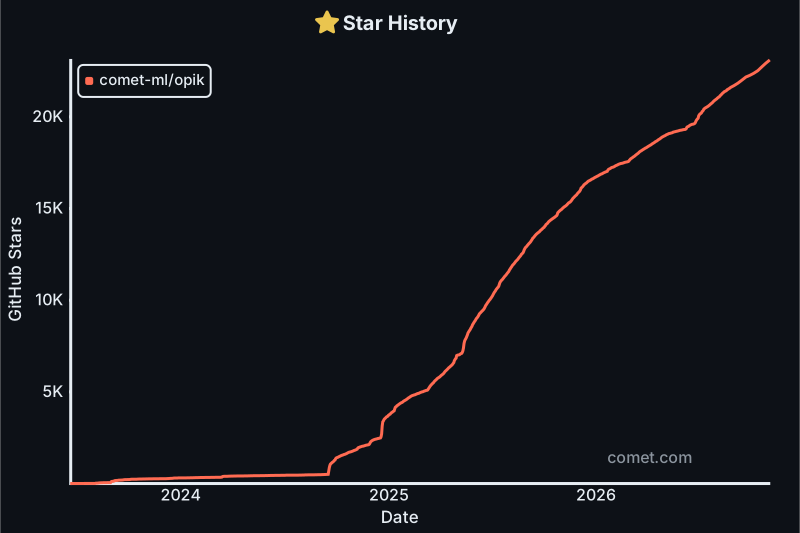
Opik is the open-source LLM observability and evaluation platform for AI agent tracing, LLM evaluation, prompt management, and production monitoring. Built by Comet. Apache-2.0 licensed, free to self-host the full platform, with 20,000+ GitHub stars.
Website โข Slack Community โข Twitter โข Changelog โข Documentation
Last updated: 2026-07-17
๐งโโ๏ธ LLM as a Judge โข ๐ Evaluating your Application โข โญ Star Us โข ๐ค Contributing
๐ What is Opik?
Opik covers the full LLM application lifecycle, from the first trace in development to production monitoring, for teams building LLM apps and AI agents. Key offerings include:
- AI Agent Tracing & Observability: Deep tracing of LLM calls, conversation logging, and agent activity, with full trace trees for multi-step agents and tool calls.
- LLM Evaluation: Datasets, experiments, and LLM-as-a-judge metrics for hallucination detection, moderation, and RAG assessment.
- Prompt & Agent Optimization: The Opik Agent Optimizer SDK to improve prompts and agents.
- Production-Ready Monitoring: Scalable dashboards and online evaluation rules.
- Opik Guardrails: Features to help you implement safe and responsible AI practices.
- CI/CD Evaluation: A PyTest integration to test LLM pipelines on every commit.
Key capabilities include:
-
Development & Tracing:
- Track all LLM calls and traces with detailed context during development and in production (Quickstart).
- Extensive 3rd-party integrations for easy observability: Seamlessly integrate with a growing list of frameworks, supporting many of the largest and most popular ones natively (including recent additions like Google ADK, Autogen, and Flowise AI). (Integrations)
- Annotate traces and spans with feedback scores via the Python SDK or the UI.
- Experiment with prompts and models in the Prompt Playground.
-
Evaluation & Testing:
- Automate your LLM application evaluation with Datasets and Experiments.
- Leverage powerful LLM-as-a-judge metrics for complex tasks like hallucination detection, moderation, and RAG assessment (Answer Relevance, Context Precision).
- Integrate evaluations into your CI/CD pipeline with our PyTest integration.
-
Production Monitoring & Optimization:
- Log high volumes of production traces: Opik is designed for scale (40M+ traces/day).
- Monitor feedback scores, trace counts, and token usage over time in the Opik Dashboard.
- Utilize Online Evaluation Rules with LLM-as-a-Judge metrics to identify production issues.
- Leverage Opik Agent Optimizer and Opik Guardrails to continuously improve and secure your LLM applications in production.
Who it's for: ML engineers building LLM-powered agents, AI teams moving from prototype to production, and engineering teams that need open-source, self-hostable observability they can run in their own environment.
Why open source matters here: Opik is Apache-2.0 licensed and free to self-host: the full platform, backend included, not just a client SDK. The repository includes the server backend, web application, tracing, datasets, experiments, evaluations, prompt management, online evaluation, and agent optimization components, all under Apache-2.0. You can run LLM observability inside your own infrastructure with no data leaving your environment and no Enterprise sales conversation required.
[!TIP]
If you are looking for features that Opik doesn't have today, please raise a new Feature request ๐
โก Quick Start
Install the Python SDK and configure it:
pip install opik
opik configure
Wrap any function with the @track decorator to start logging traces:
from opik import track
@track
def my_function(input: str) -> str:
return input
Every call to my_function is now logged to Opik, including nested calls, so this works for full agent and pipeline traces, not just single LLM calls. See the Quickstart guide for the TypeScript SDK and other setup options.
Connect your coding agent
Let Claude Code, Cursor, VS Code Copilot, Codex or opencode read your traces, score outputs and run evaluations from chat. One command sets it up. It needs uv and no SDK:
uvx opik mcp configure
The badges and the add-mcp fallback below target Opik Cloud; the command above also handles self-hosted deployments. Other MCP clients on Opik Cloud: npx add-mcp https://www.comet.com/opik/api/v1/mcp --name opik-mcp. Details, troubleshooting and FAQ are in the MCP server guide.
๐ How Does Opik Compare?
Opik competes in the LLM observability / AI agent evaluation category alongside LangSmith, Arize (Phoenix and Arize AX), Weights & Biases (Weave), Langfuse, and Braintrust.
| Capability | Opik | LangSmith | Phoenix | Arize AX | Weights & Biases (Weave) | Langfuse | Braintrust |
|---|---|---|---|---|---|---|---|
| Open source | Yes, Apache-2.0 (full platform) | No | Source-available (Elastic License 2.0, not OSI-approved) | No | Open-source SDK/toolkit; self-managed platform requires a commercial license | MIT-licensed core platform; commercial enterprise modules | No |
| Self-hosted deployment | Yes | Enterprise only | Yes | Enterprise only | Enterprise only for Weave itself | Yes, core | Enterprise only |
| Free tier available (cloud or self-hosted) | Yes, both | Yes, cloud | Yes, self-hosted | Yes, cloud | Yes, cloud | Yes, both | Yes, cloud |
| Agent / multi-step tracing | Yes | Yes | Yes | Yes | Yes | Yes | Yes |
| LLM-as-a-judge evaluation | Yes | Yes | Yes | Yes | Yes | Yes | Yes |
| Prompt management | Yes | Yes | Partly | Partly | Partly | Yes | Yes |
| Framework-agnostic | Yes | Partly, built around LangChain | Yes | Yes | Yes | Yes | Yes |
When teams choose Opik: Opik's full observability, evaluation, and optimization platform is Apache-2.0 licensed and free to self-host. Unlike closed platforms whose self-hosted deployment requires an Enterprise plan, Opik can be deployed without a commercial license, and it's framework-agnostic so it won't lock you into a single agent ecosystem. See the table above for where self-hosting and licensing differ across alternatives.
โ Frequently Asked Questions
Is Opik open source?
Opik is licensed under Apache 2.0. Its server, web application, and core observability and evaluation capabilities can be self-hosted without a commercial license.
Can I self-host Opik?
Yes. Opik can be deployed locally or in your own infrastructure using the documented self-hosting options.
Does Opik support AI agent tracing?
Yes. Opik captures multi-step traces containing LLM calls, tool executions, retrieval steps, and other agent activity.
Does Opik support LLM evaluation?
Yes. Opik supports datasets, experiments, code-based metrics, LLM-as-a-judge evaluation, and online evaluation.
Is Opik tied to a specific agent framework?
No. Opik is framework-agnostic and supports its SDK, OpenTelemetry, and framework-specific integrations.
๐ ๏ธ Opik Server Installation
Get your Opik server running in minutes. Choose the option that best suits your needs:
Option 1: Comet.com Cloud (Easiest & Recommended)
Access Opik instantly without any setup. Ideal for quick starts and hassle-free maintenance.
๐ Create your free Comet account
Option 2: Self-Host Opik for Full Control
Deploy Opik in your own environment. Choose between Docker for local setups or Kubernetes for scalability.
Self-Hosting with Docker Compose (for Local Development & Testing)
This is the simplest way to get a local Opik instance running. Note the new ./opik.sh installation script:
On Linux or Mac Environment:
## Clone the Opik repository
git clone https://github.com/comet-ml/opik.git
## Navigate to the repository
cd opik
## Start the Opik platform
./opik.sh
On Windows Environment:
## Clone the Opik repository
git clone https://github.com/comet-ml/opik.git
## Navigate to the repository
cd opik
## Start the Opik platform
powershell -ExecutionPolicy ByPass -c ".\\opik.ps1"
Installation Script Options
The opik.sh and opik.ps1 scripts support the following options:
## Start full Opik suite (default behavior)
./opik.sh
## Start only infrastructure services (databases, caches etc.)
./opik.sh --infra
## Start infrastructure + backend services
./opik.sh --backend
## Enable guardrails with any profile
./opik.sh --guardrails # Guardrails with full Opik suite
./opik.sh --backend --guardrails # Guardrails with infrastructure + backend
## Build the containers from source before starting
./opik.sh --build
## Check that all containers are healthy
./opik.sh --verify
## Stop all containers
./opik.sh --stop
## Stop all containers and remove all Opik data volumes
## WARNING: ALL OPIK DATA WILL BE LOST
./opik.sh --clean
## Show all available options
./opik.sh --help
Use the --help or --info options to troubleshoot issues. Dockerfiles now ensure containers run as non-root users for enhanced security. Once all is up and running, you can now visit localhost:5173 on your browser! For detailed instructions, see the Local Deployment Guide.
Self-Hosting with Kubernetes & Helm (for Scalable Deployments)
For production or larger-scale self-hosted deployments, Opik can be installed on a Kubernetes cluster using our Helm chart. Click the badge for the full Kubernetes Installation Guide using Helm.
๐ป Opik Client SDK
Opik provides a suite of client libraries and a REST API to interact with the Opik server. This includes SDKs for Python and TypeScript, plus first-party OpenTelemetry support: any language with an OpenTelemetry SDK โ including Java, Ruby, and .NET โ can send traces to Opik. For detailed API and SDK references, see the Opik Client Reference Documentation.
Python SDK Quick Start
To get started with the Python SDK:
Install the package:
## install using pip
pip install opik
## or install with uv
uv pip install opik
Configure the python SDK by running the opik configure command, which will prompt you for your Opik server address (for self-hosted instances) or your API key and workspace (for Comet.com):
opik configure
[!TIP]
You can also callopik.configure(use_local=True)from your Python code to configure the SDK to run on a local self-hosted installation, or provide API key and workspace details directly for Comet.com. Refer to the Python SDK documentation for more configuration options.
You are now ready to start logging traces using the Python SDK.
๐ Logging Traces with Integrations
The easiest way to log traces is to use one of our direct integrations. Opik supports a wide array of frameworks, including recent additions like Google ADK, Autogen, AG2, and Flowise AI:
| Integration | Description | Documentation |
|---|---|---|
| ADK | Log traces for Google Agent Development Kit (ADK) | Documentation |
| AG2 | Log traces for AG2 LLM calls | Documentation |
| Agent Spec | Log traces for Agent Spec calls | Documentation |
| AIsuite | Log traces for aisuite LLM calls | Documentation |
| Agno | Log traces for Agno agent orchestration framework calls | Documentation |
| Anthropic | Log traces for Anthropic LLM calls | Documentation |
| Autogen | Log traces for Autogen agentic workflows | Documentation |
| Bedrock | Log traces for Amazon Bedrock LLM calls | Documentation |
| BeeAI (Python) | Log traces for BeeAI Python agent framework calls | Documentation |
| BeeAI (TypeScript) | Log traces for BeeAI TypeScript agent framework calls | Documentation |
| BytePlus | Log traces for BytePlus LLM calls | Documentation |
| Claude Code | Log traces for Claude Code sessions via the Opik plugin | GitHub |
| Cloudflare Workers AI | Log traces for Cloudflare Workers AI calls | Documentation |
| Cohere | Log traces for Cohere LLM calls | Documentation |
| CrewAI | Log traces for CrewAI calls | Documentation |
| Cursor | Log traces for Cursor conversations | Documentation |
| DeepSeek | Log traces for DeepSeek LLM calls | Documentation |
| Dify | Log traces for Dify agent runs | Documentation |
| DSPY | Log traces for DSPy runs | Documentation |
| Fireworks AI | Log traces for Fireworks AI LLM calls | Documentation |
| Flowise AI | Log traces for Flowise AI visual LLM builder | Documentation |
| Gemini (Python) | Log traces for Google Gemini LLM calls | Documentation |
| Gemini (TypeScript) | Log traces for Google Gemini TypeScript SDK calls | Documentation |
| Groq | Log traces for Groq LLM calls | Documentation |
| Guardrails | Log traces for Guardrails AI validations | Documentation |
| Haystack | Log traces for Haystack calls | Documentation |
| Harbor | Log traces for Harbor benchmark evaluation trials | Documentation |
| Instructor | Log traces for LLM calls made with Instructor | Documentation |
| LangChain (Python) | Log traces for LangChain LLM calls | Documentation |
| LangChain (JS/TS) | Log traces for LangChain JavaScript/TypeScript calls | Documentation |
| LangGraph | Log traces for LangGraph executions | Documentation |
| Langflow | Log traces for Langflow visual AI builder | Documentation |
| LiteLLM | Log traces for LiteLLM model calls | Documentation |
| LiveKit Agents | Log traces for LiveKit Agents AI agent framework calls | Documentation |
| LlamaIndex | Log traces for LlamaIndex LLM calls | Documentation |
| Mastra | Log traces for Mastra AI workflow framework calls | Documentation |
| MCP Server (opik-mcp) | Drive Opik from Claude Code, Cursor, or VS Code via Model Context Protocol | Documentation |
| Microsoft Agent Framework (Python) | Log traces for Microsoft Agent Framework calls | Documentation |
| Microsoft Agent Framework (.NET) | Log traces for Microsoft Agent Framework .NET calls | Documentation |
| Mistral AI | Log traces for Mistral AI LLM calls | Documentation |
| n8n | Log traces for n8n workflow executions | Documentation |
| Novita AI | Log traces for Novita AI LLM calls | Documentation |
| Ollama | Log traces for Ollama LLM calls | Documentation |
| OpenAI (Python) | Log traces for OpenAI LLM calls | Documentation |
| OpenAI (JS/TS) | Log traces for OpenAI JavaScript/TypeScript calls | Documentation |
| OpenAI Agents | Log traces for OpenAI Agents SDK calls | Documentation |
| OpenClaw | Log traces for OpenClaw agent runs | Documentation |
| OpenRouter | Log traces for OpenRouter LLM calls | Documentation |
| OpenTelemetry | Log traces for OpenTelemetry supported calls | Documentation |
| OpenWebUI | Log traces for OpenWebUI conversations | Documentation |
| Pipecat | Log traces for Pipecat real-time voice agent calls | Documentation |
| Predibase | Log traces for Predibase LLM calls | Documentation |
| Pydantic AI | Log traces for PydanticAI agent calls | Documentation |
| Ragas | Log traces for Ragas evaluations | Documentation |
| Semantic Kernel | Log traces for Microsoft Semantic Kernel calls | Documentation |
| Smolagents | Log traces for Smolagents agents | Documentation |
| Spring AI | Log traces for Spring AI framework calls | Documentation |
| Strands Agents | Log traces for Strands agents calls | Documentation |
| Together AI | Log traces for Together AI LLM calls | Documentation |
| TrueFoundry | Log traces for TrueFoundry AI Gateway LLM calls | Documentation |
| TypeSafe AI | Log traces for TypeSafe AI (Jev) System One calls | Documentation |
| Vercel AI SDK | Log traces for Vercel AI SDK calls | Documentation |
| VoltAgent | Log traces for VoltAgent agent framework calls | Documentation |
| WatsonX | Log traces for IBM watsonx LLM calls | Documentation |
| xAI Grok | Log traces for xAI Grok LLM calls | Documentation |
[!TIP]
If the framework you are using is not listed above, feel free to open an issue or submit a PR with the integration.
If you are not using any of the frameworks above, you can also use the track function decorator to log traces:
import opik
opik.configure(use_local=True) # Run locally
@opik.track
def my_llm_function(user_question: str) -> str:
# Your LLM code here
return "Hello"
[!TIP]
The track decorator can be used in conjunction with any of our integrations and can also be used to track nested function calls.
๐งโโ๏ธ LLM as a Judge metrics
The Python Opik SDK includes a number of LLM as a judge metrics to help you evaluate your LLM application. Learn more about it in the metrics documentation.
To use them, simply import the relevant metric and use the score function:
from opik.evaluation.metrics import Hallucination
metric = Hallucination()
score = metric.score(
input="What is the capital of France?",
output="Paris",
context=["France is a country in Europe."]
)
print(score)
Opik also includes a number of pre-built heuristic metrics as well as the ability to create your own. Learn more about it in the metrics documentation.
๐ Evaluating your LLM Applications
Opik allows you to evaluate your LLM application during development through Datasets and Experiments. The Opik Dashboard offers enhanced charts for experiments and better handling of large traces. You can also run evaluations as part of your CI/CD pipeline using our PyTest integration.
โญ Star Us on GitHub
If you find Opik useful, please consider giving us a star! Your support helps us grow our community and continue improving the product.
๐ค Contributing
There are many ways to contribute to Opik:
- Submit bug reports and feature requests
- Review the documentation and submit Pull Requests to improve it
- Speaking or writing about Opik and letting us know
- Upvoting popular feature requests to show your support
To learn more about how to contribute to Opik, please see our contributing guidelines.
Questions
- Do Arize Phoenix and Opik list the same price?
- Both listings report Free. Free to use. Pricing is reported by the maker and is not independently verified.
- Which has more upvotes, Arize Phoenix or Opik?
- Both have 0 upvotes.
- What does each maker say Arize Phoenix and Opik are for?
- Arize Phoenix: AI observability and evaluation tool for tracing and evaluating LLM applications. Opik: Comet open-source platform for tracing, evaluating and monitoring LLM apps and agents.
Arize Phoenix alternativesยทOpik alternativesยทAll coding tools