
Milvus vs Qdrant
In short
Milvus vs Qdrant: both are coding tools on Scriptiii AI Tools. Milvus pricing: Free. Free to use. (reported by the maker) Qdrant pricing: Free. Free to use. (reported by the maker) Both have 0 upvotes.
- Milvus
- Free. Free to use. (reported by the maker)
- Qdrant
- Free. Free to use. (reported by the maker)
- Upvotes
- 0 vs 0
| Field | Milvus | Qdrant |
|---|---|---|
| Page | Milvus | Qdrant |
| Pricing (maker-reported) | Free. Free to use. | Free. Free to use. |
| Upvotes | 0 | 0 |
| Best for | ai-agents, tool, vector-databases | ai-agents, tool, vector-databases |
| Tagline | Open-source, cloud-native vector database for scalable similarity search. | Open-source vector database and similarity search engine written in Rust. |
| Website | Visit Milvus | Visit Qdrant |
Pricing and pricing details come from the maker's submission. They are not independently verified.
Milvus
What is Milvus?
🐦 Milvus is a high-performance vector database built for scale. It powers AI applications by efficiently organizing and searching vast amounts of unstructured data, such as text, images, and multi-modal information.
🧑💻 Written in Go and C++, Milvus implements hardware acceleration for CPU/GPU to achieve best-in-class vector search performance. Thanks to its fully-distributed and K8s-native architecture, Milvus can scale horizontally, handle tens of thousands of search queries on billions of vectors, and keep data fresh with real-time streaming updates. Milvus also supports Standalone mode for single machine deployment. Milvus Lite is a lightweight version good for quickstart in python with pip install.
Want to use Milvus with zero setup? Try out Zilliz Cloud ☁️ for free. Milvus is available as a fully managed service on Zilliz Cloud, with Serverless, Dedicated and BYOC options available.
For questions about how to use Milvus, join the community on Discord to get help. For reporting problems, file bugs and feature requests in GitHub Issues or ask in Discussions.
The Milvus open-source project is
under LF AI & Data Foundation, distributed with Apache 2.0 License, with Zilliz as its major contributor.
Quickstart
$ pip install -U pymilvus
This installs pymilvus, the Python SDK for Milvus. Use MilvusClient to create a client:
from pymilvus import MilvusClient
-
You can also try Milvus Lite for quickstart by installing
pymilvus[milvus-lite]. To create a local vector database, simply instantiate a client with a local file name for persisting data:client = MilvusClient("milvus_demo.db") -
You can also specify the credentials to connect to your deployed Milvus server or Zilliz Cloud:
client = MilvusClient(
  uri="<endpoint_of_self_hosted_milvus_or_zilliz_cloud>",
  token="<username_and_password_or_zilliz_cloud_api_key>")
With the client, you can create collection:
client.create_collection(
    collection_name="demo_collection",
    dimension=768,  # The vectors we will use in this demo have 768 dimensions
)
Ingest data:
res = client.insert(collection_name="demo_collection", data=data)
Perform vector search:
query_vectors = embedding_fn.encode_queries(["Who is Alan Turing?", "What is AI?"])
res = client.search(
    collection_name="demo_collection",  # target collection
    data=query_vectors,  # a list of one or more query vectors, supports batch
    limit=2,  # how many results to return (topK)
    output_fields=["vector", "text", "subject"],  # what fields to return
)
Why Milvus
Milvus is designed to handle vector search at scale. It stores vectors, which are learned representations of unstructured data, together with other scalar data types such as integers, strings, and JSON objects. Users can conduct efficient vector search with metadata filtering or hybrid search. Here are why developers choose Milvus as the vector database for AI applications:
High Performance at Scale and High Availability
- Milvus features a distributed architecture that separates compute and storage. Milvus can horizontally scale and adapt to diverse traffic patterns, achieving optimal performance by independently increasing query nodes for read-heavy workload and data node for write-heavy workload. The stateless microservices on K8s allow quick recovery from failure, ensuring high availability. The support for replicas further enhances fault tolerance and throughput by loading data segments on multiple query nodes. See benchmark for performance comparison.
Support for Various Vector Index Types and Hardware Acceleration
- Milvus separates the system and core vector search engine, allowing it to support all major vector index types that are optimized for different scenarios, including HNSW, IVF, FLAT (brute-force), SCANN, and DiskANN, with quantization-based variations and mmap. Milvus optimizes vector search for advanced features such as metadata filtering and range search. Additionally, Milvus implements hardware acceleration to enhance vector search performance and supports GPU indexing, such as NVIDIA's CAGRA.
Flexible Multi-tenancy and Hot/Cold Storage
- Milvus supports multi-tenancy through isolation at database, collection, partition, or partition key level. The flexible strategies allow a single cluster to handle hundreds to millions of tenants, also ensures optimized search performance and flexible access control. Milvus enhances cost-effectiveness with hot/cold storage. Frequently accessed hot data can be stored in memory or on SSDs for better performance, while less-accessed cold data is kept on slower, cost-effective storage. This mechanism can significantly reduce costs while maintaining high performance for critical tasks.
Sparse Vector for Full Text Search and Hybrid Search
- In addition to semantic search through dense vector, Milvus also natively supports full text search with BM25 as well as learned sparse embeddings such as SPLADE and BGE-M3. Users can store sparse vectors and dense vectors in the same collection, and define functions to rerank results from multiple search requests. See examples of Hybrid Search with semantic search + full text search.
Data Security and Fine-grain Access Control
- Milvus ensures data security by implementing mandatory user authentication, TLS encryption, and Role-Based Access Control (RBAC). User authentication ensures that only authorized users with valid credentials can access the database, while TLS encryption secures all communications within the network. Additionally, RBAC allows for fine-grained access control by assigning specific permissions to users based on their roles. These features make Milvus a robust and secure choice for enterprise applications, protecting sensitive data from unauthorized access and potential breaches.
Milvus is trusted by AI developers to build applications such as text and image search, Retrieval-Augmented Generation (RAG), and recommendation systems. Milvus powers many mission-critical businesses for startups and enterprises.
Demos and Tutorials
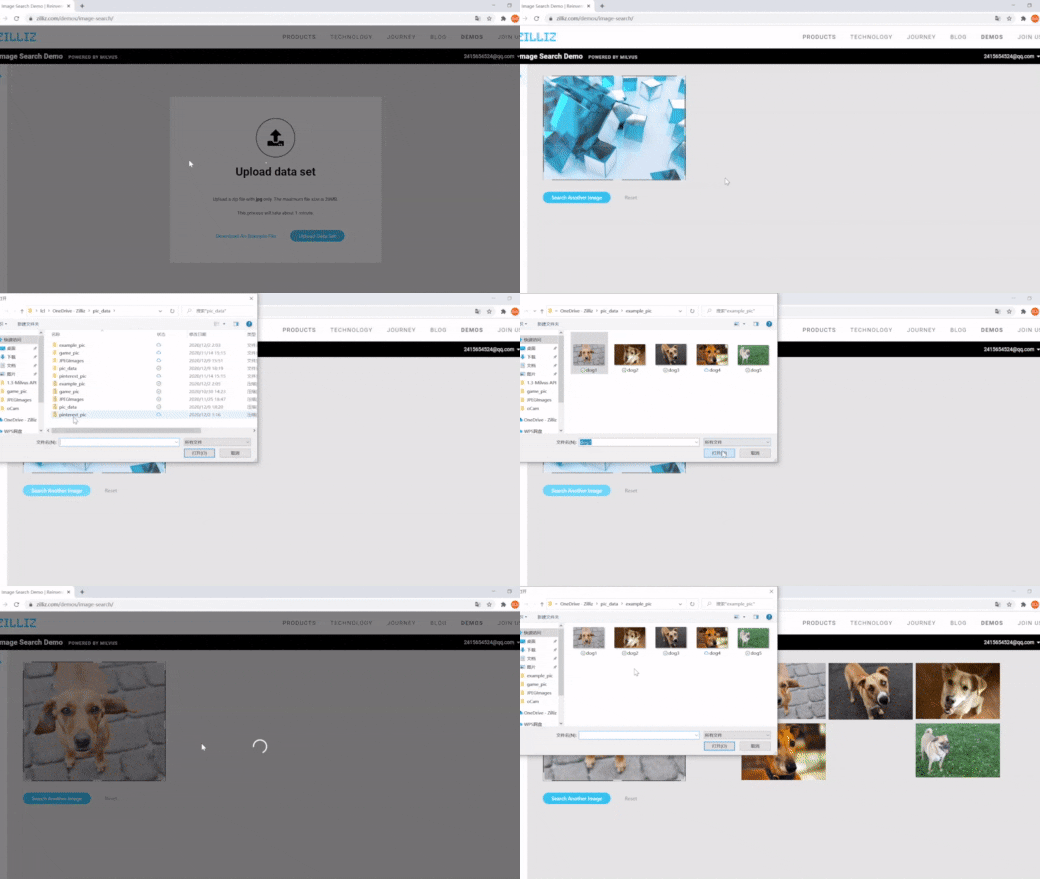
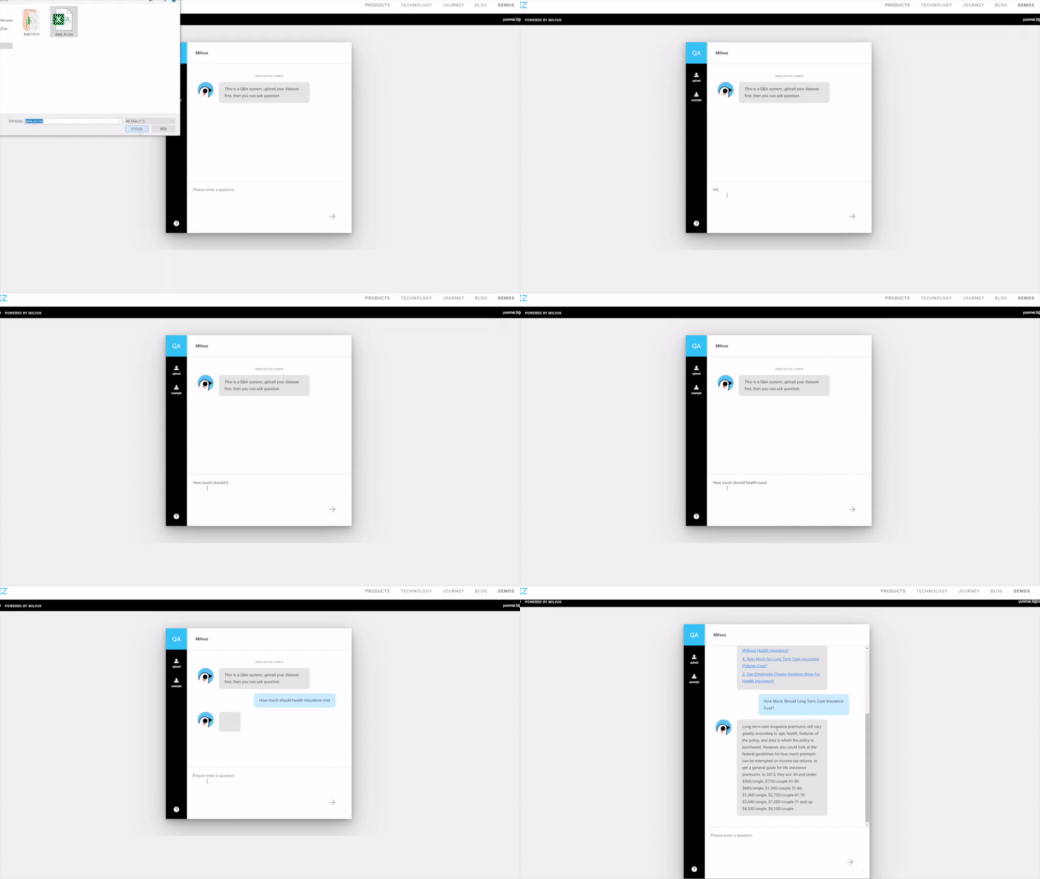
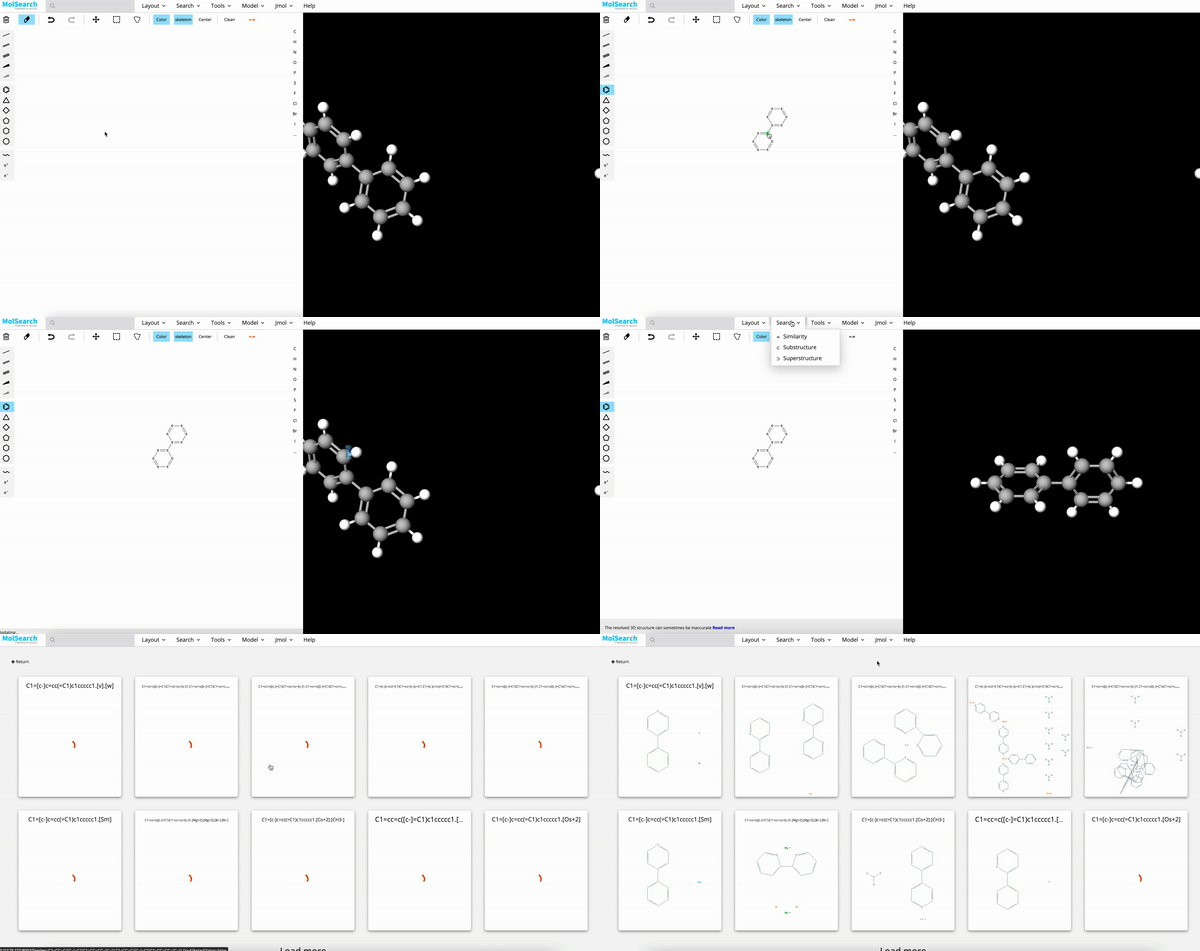
Here is a selection of demos and tutorials to show how to build various types of AI applications made with Milvus:
You can explore a comprehensive Tutorials Overview covering topics such as Retrieval-Augmented Generation (RAG), Semantic Search, Hybrid Search, Question Answering, Recommendation Systems, and various quick-start guides. These resources are designed to help you get started quickly and efficiently.
| Tutorial | Use Case | Related Milvus Features |
|---|---|---|
| Build RAG with Milvus | RAG | vector search |
| Advanced RAG Optimizations | RAG | vector search, full text search |
| Full Text Search with Milvus | Text Search | full text search |
| Hybrid Search with Milvus | Hybrid Search | hybrid search, multi vector, dense embedding, sparse embedding |
| Image Search with Milvus | Semantic Search | vector search, dynamic field |
| Multimodal Search using Multi Vectors | Semantic Search | multi vector, hybrid search |
| Movie Recommendation with Milvus | Recommendation System | vector search |
| Graph RAG with Milvus | RAG | graph search |
| Contextual Retrieval with Milvus | Quickstart | vector search |
| Vector Visualization | Quickstart | vector search |
| HDBSCAN Clustering with Milvus | Quickstart | vector search |
| Use ColPali for Multi-Modal Retrieval with Milvus | Quickstart | vector search |
Ecosystem and Integration
Milvus integrates with a comprehensive suite of AI development tools, such as LangChain, LlamaIndex, OpenAI and HuggingFace, making it an ideal vector store for GenAI applications such as Retrieval-Augmented Generation (RAG). Milvus works with both open-source embedding models and embedding services, in text, image and video modalities. Milvus also provides a convenient utility pymilvus[model], users can use the simple wrapper code to transform unstructured data into vector embeddings and leverage reranking models for optimized search results. The Milvus ecosystem also includes Attu for GUI-based administration, Birdwatcher for system debugging, Prometheus/Grafana for monitoring, Milvus CDC for data synchronization, VTS for data migration and data connectors for Spark, Kafka, Fivetran, and Airbyte to build search pipelines.
Check out https://milvus.io/docs/integrations_overview.md for more details.
Documentation
For guidance on installation, usage, deployment, and administration, check out Milvus Docs. For technical milestones and enhancement proposals, check out issues on GitHub.
Contributing
The Milvus open-source project accepts contributions from everyone. See Guidelines for Contributing for details on submitting patches and the development workflow. See our community repository to learn about project governance and access more community resources.
Build Milvus from Source Code
Requirements:
-
Linux systems (Ubuntu 20.04 or later recommended):
Go: >= 1.21 CMake: >= 3.26.4 && CMake < 4 GCC: >= 11 Python: > 3.8 and <= 3.11 -
MacOS systems with x86_64 (Big Sur 11.5 or later recommended):
Go: >= 1.21 CMake: >= 3.26.4 && CMake < 4 llvm: >= 15 Python: > 3.8 and <= 3.11 -
MacOS systems with Apple Silicon (Monterey 12.0.1 or later recommended):
Go: >= 1.21 (Arch=ARM64)
CMake: >= 3.26.4 && CMake < 4
llvm: >= 15
Python: > 3.8 and  <= 3.11
Clone Milvus repo and build.
## Clone github repository.
$ git clone https://github.com/milvus-io/milvus.git

## Install third-party dependencies.
$ cd milvus/
$ ./scripts/install_deps.sh

## Compile Milvus.
$ make
For full instructions, see developer's documentation.
Community
Join the Milvus community on Discord to share your suggestions, advice, and questions with our engineering team.
To learn the latest news about Milvus, follow us on social media:
You can also check out our FAQ page to discover solutions or answers to your issues or questions, and subscribe to Milvus mailing lists:
Reference
Reference to cite when you use Milvus in a research paper:
@inproceedings{2021milvus,
  title={Milvus: A Purpose-Built Vector Data Management System},
  author={Wang, Jianguo and Yi, Xiaomeng and Guo, Rentong and Jin, Hai and Xu, Peng and Li, Shengjun and Wang, Xiangyu and Guo, Xiangzhou and Li, Chengming and Xu, Xiaohai and others},
  booktitle={Proceedings of the 2021 International Conference on Management of Data},
  pages={2614--2627},
  year={2021}
}

@article{2022manu,
  title={Manu: a cloud native vector database management system},
  author={Guo, Rentong and Luan, Xiaofan and Xiang, Long and Yan, Xiao and Yi, Xiaomeng and Luo, Jigao and Cheng, Qianya and Xu, Weizhi and Luo, Jiarui and Liu, Frank and others},
  journal={Proceedings of the VLDB Endowment},
  volume={15},
  number={12},
  pages={3548--3561},
  year={2022},
  publisher={VLDB Endowment}
}






























Qdrant

Vector Search Engine for the next generation of AI applications
Qdrant (read: quadrant) is a vector similarity search engine and vector database.
It provides a production-ready service with a convenient API to store, search, and manage points—vectors with an additional payload.
Qdrant is tailored for extended filtering support, making it useful for all sorts of neural-network or semantic-based matching, faceted search, and other applications.
Qdrant is written in Rust 🦀, which makes it fast and reliable even under high load. See benchmarks.
With Qdrant, embeddings or neural network encoders can be turned into full-fledged applications for matching, searching, recommending, and much more!
Qdrant is also available as a fully managed Qdrant Cloud ⛅ including a free tier.
Quick Start • Agent Skills • Client Libraries • Demo Projects • Integrations • Contact
Getting Started
Agent Skills
Qdrant provides a collection of ready-to-use agent skills that bring Qdrant's vector search capabilities directly into your AI coding assistant. Install these skills to empower your agent in making critical engineering decisions for optimal vector search performance, such as quantization, sharding, tenant isolation, hybrid search, model migration, and more.
Client-Server
To experience the full power of Qdrant locally, run the container with this command:
docker run -p 6333:6333 qdrant/qdrant
Note that this starts an insecure deployment without authentication, open to all network interfaces. Please refer to secure your instance.
Now you can connect to the server with any client. For example, using Python:
from qdrant_client import QdrantClient

client = QdrantClient(url="http://localhost:6333")
Before deploying Qdrant to production, be sure to read our installation and security guides.
Clients
Qdrant offers the following client libraries to help you integrate it into your application stack:
- Official:
- Community:
Qdrant Edge
Qdrant Edge is a lightweight version of Qdrant designed for edge devices and resource-constrained environments. Unlike Qdrant Server, which uses a client-server architecture, Qdrant Edge runs inside the application process. Data is stored and queried locally and can be synchronized with a Qdrant server. It offers the same powerful vector search capabilities as the client-server version but with a smaller footprint, making it ideal for applications that require low latency and offline functionality.
To get started with Qdrant Edge from Python or Rust, initialize an instance of EdgeShard, which exposes methods to manage data, query it, and restore snapshots. For example:
from qdrant_edge import Distance, EdgeConfig, EdgeVectorParams, EdgeShard, Point, UpdateOperation

shard = EdgeShard.create("./shard", EdgeConfig(
    vectors={"my-vector": EdgeVectorParams(size=4, distance=Distance.Cosine)}
))
shard.update(UpdateOperation.upsert_points([
    Point(id=1, vector={"my-vector": [0.1, 0.2, 0.3, 0.4]}, payload={"color": "red"})
]))
Where Do I Go from Here?
- Quick Start Guide
- Detailed Documentation
- Take the Qdrant Essentials course
- Follow this tutorial to create a semantic search engine with Qdrant
Demo Projects
Discover Semantic Text Search 🔍
Unlock the power of semantic embeddings with Qdrant, transcending keyword-based search to find meaningful connections in short texts. Deploy a neural search in minutes using a pre-trained neural network, and experience the future of text search. Try it online!
Explore Similar Image Search - Food Discovery 🍕
There's more to discovery than text search, especially when it comes to food. People often choose meals based on appearance rather than descriptions and ingredients. Let Qdrant help your users find their next delicious meal using visual search, even if they don't know the dish's name. Check it out!
Master Extreme Classification - E-Commerce Product Categorization 📺
Enter the cutting-edge realm of extreme classification, an emerging machine learning field tackling multi-class and multi-label problems with millions of labels. Harness the potential of similarity learning models, and see how a pre-trained transformer model and Qdrant can revolutionize e-commerce product categorization. Play with it online!
API
REST
Qdrant provides a REST API with an OpenAPI 3.0 specification, enabling client generation for virtually any framework or programming language.
You can also download the raw OpenAPI definitions.
gRPC
For faster, production-tier searches, Qdrant also provides a gRPC interface.
Features
Dense, Sparse, and Multi Vector Search
Qdrant supports dense vectors for semantic similarity, sparse vectors for full-text search, and multivector search for objects with multiple embeddings or late interaction models like ColBERT.
Filtering on Payload
Attach any JSON payload to your vectors and filter on it using a rich set of conditions—keyword matching, full-text, numeric ranges, geo-locations, and more—combined with should, must, and must_not clauses.
Hybrid Search
Combine multiple vectors in a single query to get the best of semantic understanding and keyword precision, with results merged via configurable fusion strategies, such as Reciprocal Rank Fusion (RRF) and Distribution-Based Score Fusion (DBSF).
Vector Quantization and On-Disk Storage
Built-in quantization cuts RAM usage by up to 97% and lets you tune the trade-off between search speed and precision.
Distributed Deployment
Scale horizontally with sharding and replication, and update or resize collections with zero downtime.
Highlighted Features
- Faceting - aggregate search results by payload values.
- Recommendation - use positive and negative examples to find similar points.
- Discovery - constrain search to a specific region of the vector space.
- Search Relevance Tuning - tools for adjusting search results, such as Maximal Marginal Relevance (MMR) and the Relevance Feedback Query.
- Multitenancy - scalable partitioning of data for multi-user environments.
- Observability - comprehensive metrics, telemetry, and audit logging for monitoring and debugging.
- Query Planning and Payload Indexes - leverages stored payload information to optimize query execution strategy.
- SIMD Hardware Acceleration - utilizes modern CPU x86-x64 and Neon architectures to deliver better performance.
- GPU Support - for accelerated indexing, with support for NVIDIA and AMD GPUs.
- Async I/O - uses
io_uringto maximize disk throughput utilization even on network-attached storage. - Write-Ahead Logging - ensures data persistence with update confirmation, even during power outages.
Web UI
Web UI provides a visual way to interact with your data and monitor the health of your deployment. It enables you to explore your collections, manage data, interact with the REST API, and more.
Integrations
Qdrant integrates with the tools you're already using across every stage of your AI stack. You can connect to embedding providers, AI application frameworks, and data pipeline tools, as well as observability platforms for monitoring and tracing your vector search in production. No-code and low-code automation platforms are supported too. Refer to the Ecosystem page for the complete list.
Contributing
We are happy to receive your contributions! Before opening a pull request, please read our Contributing Guide.
[!IMPORTANT]
Our development branch isdev, notmaster. Please fork the repo, branch fromdev, and open your pull request againstdev. PRs targetingmasterwill be asked to retarget.
Contacts
- Have questions? Join our Discord channel or mention @qdrant_engine on X
- Want to stay in touch with the latest releases? Subscribe to our Newsletters
- Looking for a managed cloud? Check pricing. Need something personalized? We're at info@qdrant.tech
License
Qdrant is licensed under the Apache License, Version 2.0. View a copy of the License file.
Questions
- Do Milvus and Qdrant list the same price?
- Both listings report Free. Free to use. Pricing is reported by the maker and is not independently verified.
- Which has more upvotes, Milvus or Qdrant?
- Both have 0 upvotes.
- What does each maker say Milvus and Qdrant are for?
- Milvus: Open-source, cloud-native vector database for scalable similarity search. Qdrant: Open-source vector database and similarity search engine written in Rust.